

This desk review from the Veynuus Research Department brings together published laws, plans, statistics, budget reports, project documents and research on higher education in Somalia, with evidence through 6 November 2026. It sets out what the evidence shows, what we think the sector needs, and our own estimates where official figures stop.
What the evidence shows
Somalia's universities grew after 1991 through communities, private providers and the diaspora. The federal government reopened Somali National University in 2014 and, on 4 December 2024, gave the sector a statutory regulator through Higher Education Law No. 30, with commissioners appointed in August 2025.
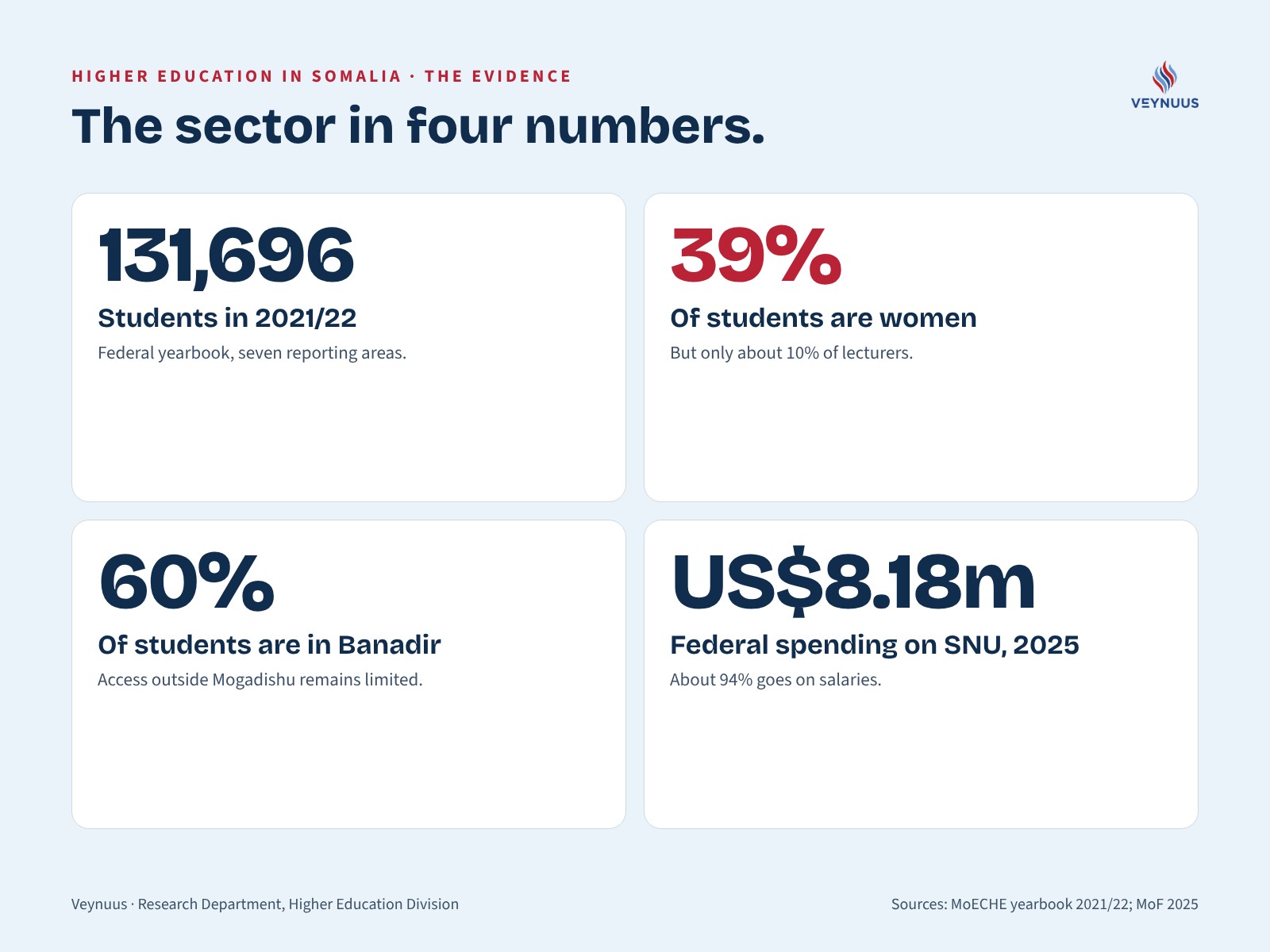
- Scale: the 2021/22 federal yearbook counted 131,696 students; women were 39% of students but only about 10% of lecturers.
- Concentration: Banadir held 60% of students; Banadir and Somaliland together about 82%.
- Public money: federal spending on SNU rose from US$3.87 million in 2019 to US$8.18 million in 2025, about 94% of it on salaries.
- Donor money: the US$52 million Rajo Kaaba package and a €2 million EU systems-strengthening tender are the largest current commitments.
- Quality: 96% of 52 institutions assessed in 2026 were at the foundational or emerging stage of digital readiness, and evidence on graduate jobs is thin.
What higher education needs: the Veynuus view
- One reliable data system: an annual HEMIS census with stable IDs for every institution, campus and programme.
- Quality at programme level: published accreditation decisions with validity dates and minimum standards.
- Ways to pay beyond fees: scholarships, student finance and a pooled fund with banks and investors.
- Links to work: internships, employer input into curricula and yearly graduate tracer studies.
- Learning from major projects: a shared platform to open up the data, lessons and placements of projects such as Baxnaano, BOOST-YOU, Rajo Kaaba and JOSP.
- Faculty and women in teaching: staff development and a path beyond 10% women lecturers.
- Reach beyond Mogadishu: specialised, well-resourced institutions in every member state.
- Research and digital capacity: applied research funding and investment in campus systems.
Veynuus numbers and assumptions
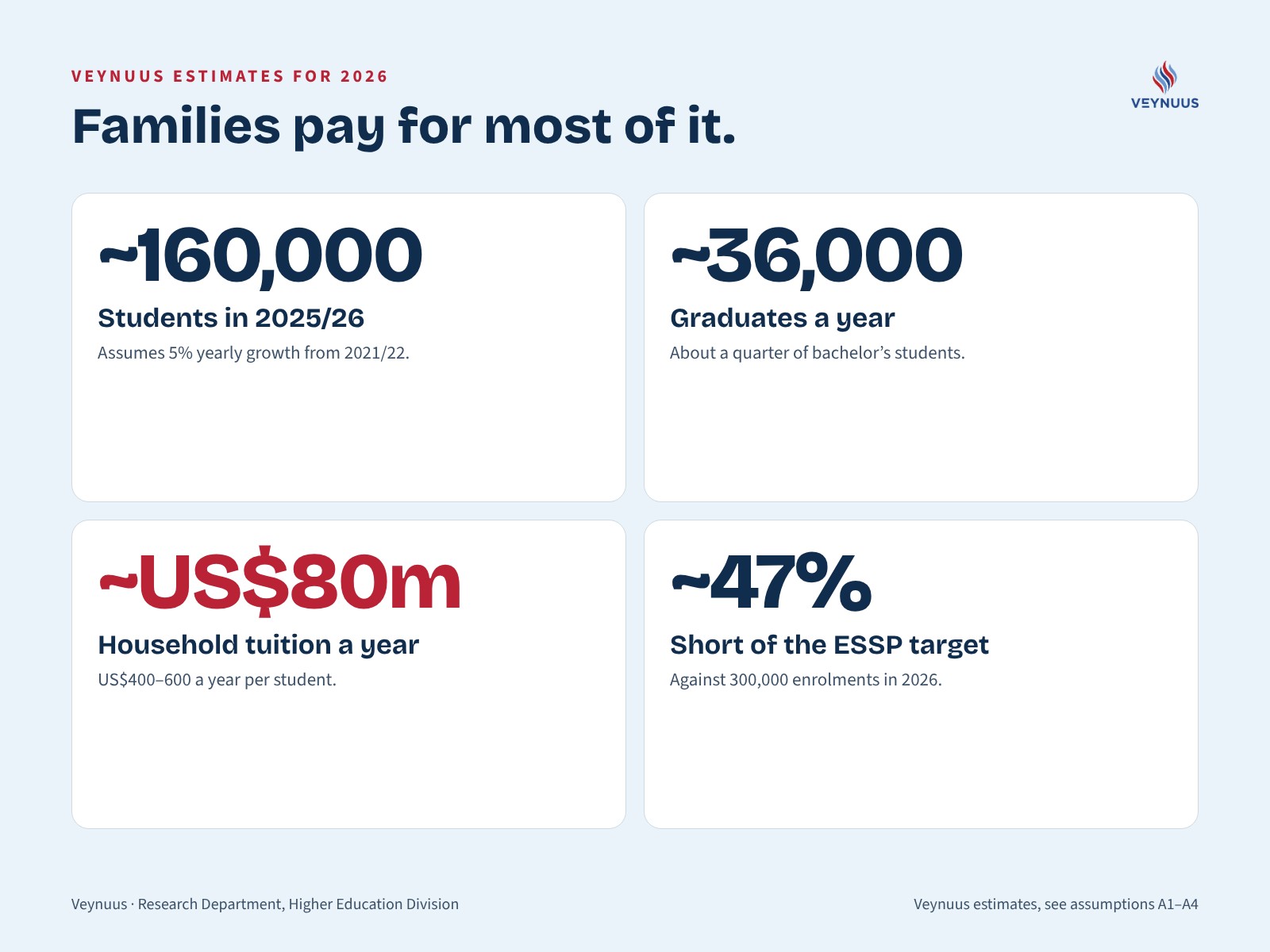
Official figures stop in 2021/22 for most of the country. Our estimates for 2026, each built on a stated assumption, are: about 160,000 students (5% yearly growth from 2021/22), about 36,000 graduates a year, about US$80 million a year in household tuition (US$400–600 per student, roughly ten times federal spending on SNU), and a shortfall of about 47% against the ESSP target of 300,000 enrolments. Families, not government or donors, pay for most of Somali higher education.
What comes next
This review is the first step. Our next industry publication will be deep primary research by Veynuus across Somalia, led by the flagship study Degrees Without Direction, alongside a graduate tracer study, an employer skills demand survey, The Cost of a Degree, Women in Somali Higher Education, accreditation readiness, research capacity, digital learning, TVET and university pathways, higher education in the member states, health professions education, and scholarships and mobility.
The full 19-page review, with 86 cited sources, abbreviations and detailed tables, is available from the Research Department at partnerships@veynuus.com. It was prepared as background for the Veynuus Industry Talk on 25 November 2026.
Research Department · Higher Education Division, Veynuus. November 2026.